Traffic Volumes
Building Internal Traffic Analysis Capacity: A Roadmap for Reducing Consultant Reliance
Cities cut consultant reliance with mobility data to validate traffic calming, stop-control requests, and speed concerns using Urban SDK.
Municipal traffic engineering teams across the country are under growing pressure. Resident expectations for fast responses are increasing. Traffic calming and all-way stop requests are rising. Speeding complaints require quicker validation. And with limited staff and resources, many cities struggle to keep up.
For decades, the default solution has been to hire traffic consultants. Consultants provide traffic counts, turning movement data, speed studies, and formal engineering reports that cities rely on when making safety and traffic management decisions. But over time, consultant dependency has become costly, slow, and unsustainable — especially for fast-growing communities with high request volumes.
Today, a new trend is emerging: building internal traffic analysis capacity using automated mobility data, modern dashboards, and digital workflows. Cities no longer need to outsource every count or every report. With tools, internal teams can now access the data they need instantly, analyze traffic patterns confidently, and respond to residents faster — all while reducing consultant costs.
A leading example of this shift is the City of El Cajon, California, where the traffic division used Urban SDK to validate traffic calming requests, review 85th percentile speeds, confirm traffic volume ranges, and dramatically reduce reliance on external consultants.
In this blog, we explore why cities depend so heavily on consultants, the hidden costs of outsourcing, and how a modern, data-driven approach helps cities build internal capacity for long-term operational efficiency.
Why Cities Rely Heavily on Traffic Consultants Today
Although consultants offer valuable expertise, the reason cities depend on them so frequently often comes down to structural challenges inside municipal operations.
Below are the three most common causes.
Staff shortages
Many city traffic divisions operate with a small team responsible for:
- Reviewing resident complaints
- Performing traffic calming evaluations
- Conducting stop-control analyses
- Supporting engineering design
- Coordinating with police for enforcement
- Managing capital improvement projects
- Evaluating grant applications
- Handling school traffic safety
- Responding to city leadership
With limited staff, cities simply do not have enough internal resources to perform dozens of speed studies, volume evaluations, or TMCs every month. Outsourcing becomes a survival mechanism.
Limited in-house technical skillsets
Modern traffic analysis requires:
- Understanding speed profiles
- Applying MUTCD warrants
- Conducting delay and queue assessments
- Reviewing volume variability
- Interpreting continuous data
- Running scenario comparisons
- Writing technical reports
Smaller cities may not have dedicated transportation engineers or analysts with the specialized skillsets required for advanced traffic evaluations.
For these cities, consultants fill the knowledge gap.
High volume of requests
Growing cities receive constant requests from:
- Residents
- HOAs
- School administrators
- Councilmembers
- Business owners
- Law enforcement
Many of these requests require data verification or formal analysis. When internal teams are overwhelmed, consultant studies become the default method for keeping up.
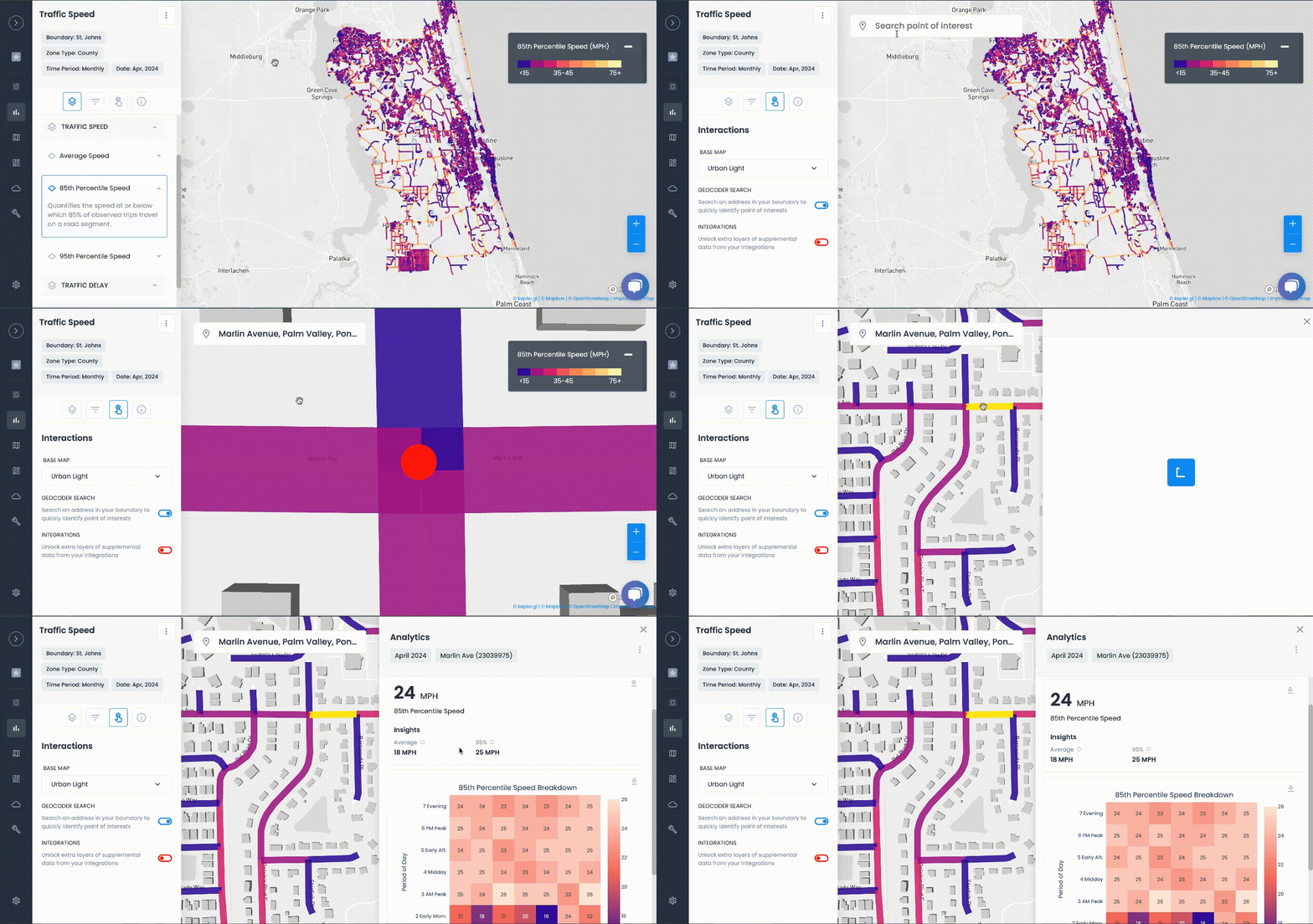
Urban SDK provides a way to analyze data internally.
Hidden Costs of Consultant Dependency
While consultants provide value, relying on them for routine studies creates several hidden costs that are often overlooked.
Long wait times
Consultant studies require:
- Procurement approvals
- Scheduling
- Field deployment time
- Data retrieval
- Analysis
- Report preparation
This can take weeks or months, slowing down decision-making and frustrating residents. When the public doesn’t receive timely answers, they naturally escalate their concerns — creating additional workload for staff.
Budget strain
Consultant studies can cost anywhere from:
- $3,500 to $7,500 for simple speed or volume counts
- $10,000+ for turning movement counts and analysis
- $15,000–$30,000 for corridor studies or stop-control evaluations
For cities receiving dozens of requests annually, these costs accumulate quickly.
By building internal analysis capacity, cities can significantly reduce annual consulting fees.
Inconsistent methodologies
Consultants may:
- Use different data collection windows
- Apply different assumptions
- Use slightly different equipment
- Deliver varying levels of detail
This can make it difficult to compare one study to another — especially when conducted months or years apart.
Urban SDK solves this by giving cities consistent, standardized datasets for every street segment, improving continuity in analysis.
How Cities Can Start Building Internal Analysis Capacity
Building internal traffic analysis capacity doesn’t require hiring large teams. Instead, cities can integrate modern tools and workflows that empower existing staff to handle more work internally.
Below is a straightforward roadmap.
1. Establish standardized processes
Cities should create repeatable workflows for:
- Speed complaint validation
- Traffic calming evaluations
- All-way stop warrant reviews
- Volume analysis
- Safety screening
These processes should define:
- Required datasets
- Analysis steps
- Decision thresholds
- Communication templates
- Resident response language
With standardized workflows, staff can complete requests consistently and defensibly.
Urban SDK helps cities build these workflows by providing consistent data inputs for speed, volume, and trends.
2. Train teams on traffic data literacy
Building internal capacity requires staff who can confidently interpret data, especially:
- 85th percentile speeds
- Average and median speeds
- Speed distributions
- Hourly traffic volumes
- Seasonal variability
- Gap availability
- Delay patterns
Training does not need to be highly technical. It can be practical, actionable, and supported through:
- Internal workshops
- Online traffic engineering resources
- Onboarding materials for new staff
- Urban SDK training sessions
El Cajon’s traffic division benefited from Urban SDK’s training and support to help staff understand how to extract insights efficiently.
3. Use automated speed and volume data
The biggest bottleneck for most cities is the time required to deploy equipment or wait for studies. Automated data access solves this instantly.
With Urban SDK, cities can:
- Review speeds for any roadway segment
- Validate the 85th percentile
- Check traffic volumes
- Identify hourly or seasonal patterns
- Compare consultant counts
- Validate or rule out speeding complaints
- Review segment history over time
Tools That Support Internal Traffic Teams
Modern cities use three categories of tools to build internal capacity: dashboards, automated reporting, and self-service analysis platforms.
Dashboards for volume and speed
Dashboards give city staff:
- Real-time and historical speed data
- Traffic volume trends
- Peak-hour visualizations
- Seasonal variability charts
- Safety indicators
Urban SDK’s dashboards make these insights accessible without needing complex software or advanced engineering degrees.
Automated report generation
Cities benefit from the ability to quickly generate:
- Speed summaries
- Volume summaries
- 85th percentile charts
- Speed distribution graphs
- Intersection comparison reports
Automated reporting allows staff to respond to resident emails and leadership requests with clear, visual data summaries — without writing lengthy engineering documents each time.
Self-service analysis environments
A true internal capacity shift happens when staff can analyze data independently without needing to wait for external support.
Urban SDK provides a self-service environment where staff can:
- Select any roadway segment
- View near-real-time mobility data
- Extract speed and volume trends
- Compare historical and current patterns
- Validate traffic calming or stop-control needs
This makes traffic analysis part of routine operations, not an outsourced process.
Benefits of Reducing Consultant Reliance
Cities that build internal capacity experience major operational improvements.
Faster decision-making
Internal teams can respond to requests:
- Within hours or days
- Instead of weeks or months
This reduces backlog, improves workflow efficiency, and enhances public satisfaction.
Cost savings
Reducing consultant dependence can save cities:
- Tens of thousands of dollars annually
- Hundreds of thousands over multi-year periods
These savings can be reinvested into:
- Capital projects
- Traffic calming installations
- Staff development
- Technology upgrades
Greater operational control
When cities rely heavily on consultants, they must operate on someone else’s schedule. Internal capacity offers:
- More predictable timelines
- Consistent data methodologies
- Faster communication across departments
- Simplified public responses
Conclusion
Cities can modernize their traffic operations by shifting from outsourced studies to internal, data-driven workflows. Relying solely on consultants is no longer sustainable for communities facing rapid growth, rising public expectations, and increasing demand for transparency. By building internal capacity and using continuous mobility datasets, municipal traffic teams can validate speeding concerns, evaluate traffic calming requests, review stop-control warrants, and communicate decisions far more quickly and consistently.
Urban SDK empowers cities to access real-time speed and volume data, standardize evaluation processes, reduce consultant dependence, and deliver faster, more accurate responses to residents. This hybrid model—where consultants are used strategically and internal teams leverage continuous data—represents the future of modern, efficient, and resilient traffic engineering.
Frequently Asked Questions
1. Why do cities rely so heavily on traffic consultants?
Cities often face staffing shortages, high volumes of resident requests, and limited in-house technical expertise. Consultants help fill these gaps, but reliance becomes costly and slow over time.
2. How can cities reduce their dependence on traffic consultants?
By adopting continuous mobility data, standardized workflows, dashboards, and self-service analysis tools, internal teams can perform many studies without waiting for consultant availability.
3. What types of traffic studies can cities handle internally?
With modern data, cities can internally evaluate 85th percentile speeds, speed complaints, traffic calming requests, stop-control warrants, volume variability, and seasonal traffic patterns.
4. How much do traditional traffic studies cost cities?
Consultant studies commonly cost $3,500–$7,500 for basic counts, $10,000+ for turning movement counts, and $15,000–$30,000 for corridor or stop-control evaluations—adding up quickly for growing cities.
5. What are the hidden costs of consultant reliance?
Beyond direct fees, cities face delays, long procurement timelines, inconsistent methodologies, slow resident responses, and difficulty comparing studies completed months or years apart.
6. How does continuous mobility data help internal staff work faster?
Continuous datasets provide instant access to speed and volume trends—no equipment, no field deployment, no retrieval—allowing staff to validate requests within minutes instead of weeks.
7. What skills do staff need to build internal traffic analysis capacity?
Teams should understand 85th percentile speeds, volume variability, speed distributions, queueing/delay concepts, and basic MUTCD warrants.
8. Can cities still use consultants after building internal capacity?
Yes. Consultants remain valuable for complex corridor studies or engineering design, but internal teams can handle routine evaluations, validations, and data-driven resident responses.
9. How does building internal capacity improve public satisfaction?
Faster responses, clearer data, and consistent decisions increase transparency and reduce resident frustration—leading to stronger trust between communities and city staff.

TRAFFIC ENFORCEMENT FEATURES
80% of citizen complaints
are a perception problem
Urban SDK provides precise hourly speed data to evaluate complaints and deploy resources efficiently for the greatest impact to public safety.
Urban SDK provides precise hourly speed data to evaluate complaints and deploy resources efficiently for the greatest impact to public safety.

Target Speeding
Identify hot spots, validate monthly speeding trends and monitor vulnerable areas like school zones.

Improve Safety
Crash and citations location information to compare speed trends month over month

Fast Response
Respond to citizen complaints sooner with address search and exportable reporting

Deploy Assets
Generate maps for traffic enforcement by time of day, location or division to deploy officers to known problem areas.
RESOURCES
Customer Success
See how public sector leaders succeed with Urban SDK.


WEBINAR
Identify speeding and proactively enforce issues
See just how quick and easy it is to identify speeding, address complaints, and deploy officers.