Traffic Calming
How Cities Can Replace Physical Speed Studies With Continuous Roadway Monitoring
Cities use continuous road monitoring to validate speeding complaints faster, cut costs, and improve traffic safety with Urban SDK.
Municipal traffic teams have relied on physical speed studies for decades. The process is familiar: identify a concern, deploy speed counters, collect several days of data, retrieve equipment, download the results, analyze them, and issue a conclusion. While this approach once made sense, it no longer fits the needs of modern communities — especially communities experiencing rapid growth, rising traffic volumes, and increased expectations for faster municipal response.
Today’s residents want answers right now. They want clear, transparent, trustworthy data. And they want their cities to use modern tools to keep streets safe — not outdated methods that delay action for weeks.
Across the United States, cities are recognizing that physical speed studies are too slow, too costly, too inconsistent, and too inflexible to keep up with the demands of modern traffic safety management. Fortunately, new digital tools, mobility datasets, and geospatial AI now make it possible to monitor roadway speeds continuously — without deploying equipment, without waiting weeks for results, and without relying on small data samples.
Urban SDK is one of the platforms leading this shift. Dozens of cities including Manheim Township, Pennsylvania have already replaced most physical speed studies with continuous roadway monitoring through Urban SDK. What once took the Township weeks now takes minutes.
This blog will explain why physical speed studies are becoming outdated, how continuous monitoring works, the benefits cities instantly gain, and what the future of digital traffic analysis looks like.
The Limitations of Traditional Physical Speed Studies
Physical speed studies have been the backbone of traffic engineering for years, but their limitations are significant — and becoming more obvious as cities expand.
High cost and staff requirements
Field-based studies require multi-step, labor-heavy workflows:
- Transporting radar equipment or pneumatic tubes
- Locating safe installation points
- Scheduling deployments around weather or staff availability
- Waiting days for data collection
- Returning to retrieve equipment
- Downloading data manually
- Cleaning datasets
- Writing reports
For many municipalities, one study can consume, at minimum, 10–20 hours of staff time.
For a city handling 100+ complaints per year, this quickly overwhelms engineering and police departments.
Manheim Township experienced this firsthand. Before adopting Urban SDK, their officers and engineers routinely spent several weeks per study — resulting in delayed answers and rising citizen frustration.
Slow turnaround time
A typical physical speed study takes:
- 3–10 days to schedule
- 3–7 days of data collection
- 1–3 days for retrieval and analysis
Total time: 7–20 days before a resident receives an answer.
During this waiting period:
- Enforcement decisions are delayed
- Frustrated residents follow up repeatedly
- Traffic safety issues remain unaddressed
- City staff must juggle complaint backlogs
This lag creates tension: residents expect fast answers, but cities cannot move any faster when tied to physical equipment.
Data inconsistencies and limited sample size
Physical studies can only capture a small slice of behavior. They:
- Collect data only for short periods
- Cannot capture seasonal variation
- May miss morning/evening patterns
- May not reflect typical conditions
- May give misleading results if weather or nearby construction changes traffic flow
If the study happens to land on a holiday week, the data becomes even less accurate.
Continuous monitoring solves this by capturing every day, every hour, every driver, not just a one-time snapshot.
What Continuous Roadway Monitoring Looks Like Today
Continuous monitoring is no longer theoretical. Modern mobility datasets, GPS telemetry, and geospatial AI allow cities to access roadway data as easily as checking a weather app.
Urban SDK brings these datasets together into one place.
Sensors, GPS, mobility datasets, geospatial AI
Where physical speed studies rely on one type of data (pneumatic tube counters or radar), continuous monitoring blends multiple sources:
- GPS data from connected vehicles
- Roadway sensors
- Satellite or aerial mapping
- Geospatial machine learning
- Traffic signal analytics
- Manual report overlays
Urban SDK compiles these into a single, unified, accurate view of:
- Speeding trends
- Speed percentiles
- Speed variation by time of day
- Traffic volume
- Peak travel behavior
- Hotspot road segments
This eliminates the need for guesswork or site-by-site deployments.
Real-time vs. near-real-time access
Most cities today rely on data that becomes available days or weeks after collection.
Continuous data platforms provide:
- Daily updated speeds
- Rolling historical comparisons
- Instant speed lookups for any segment
- Time-of-day pattern recognition
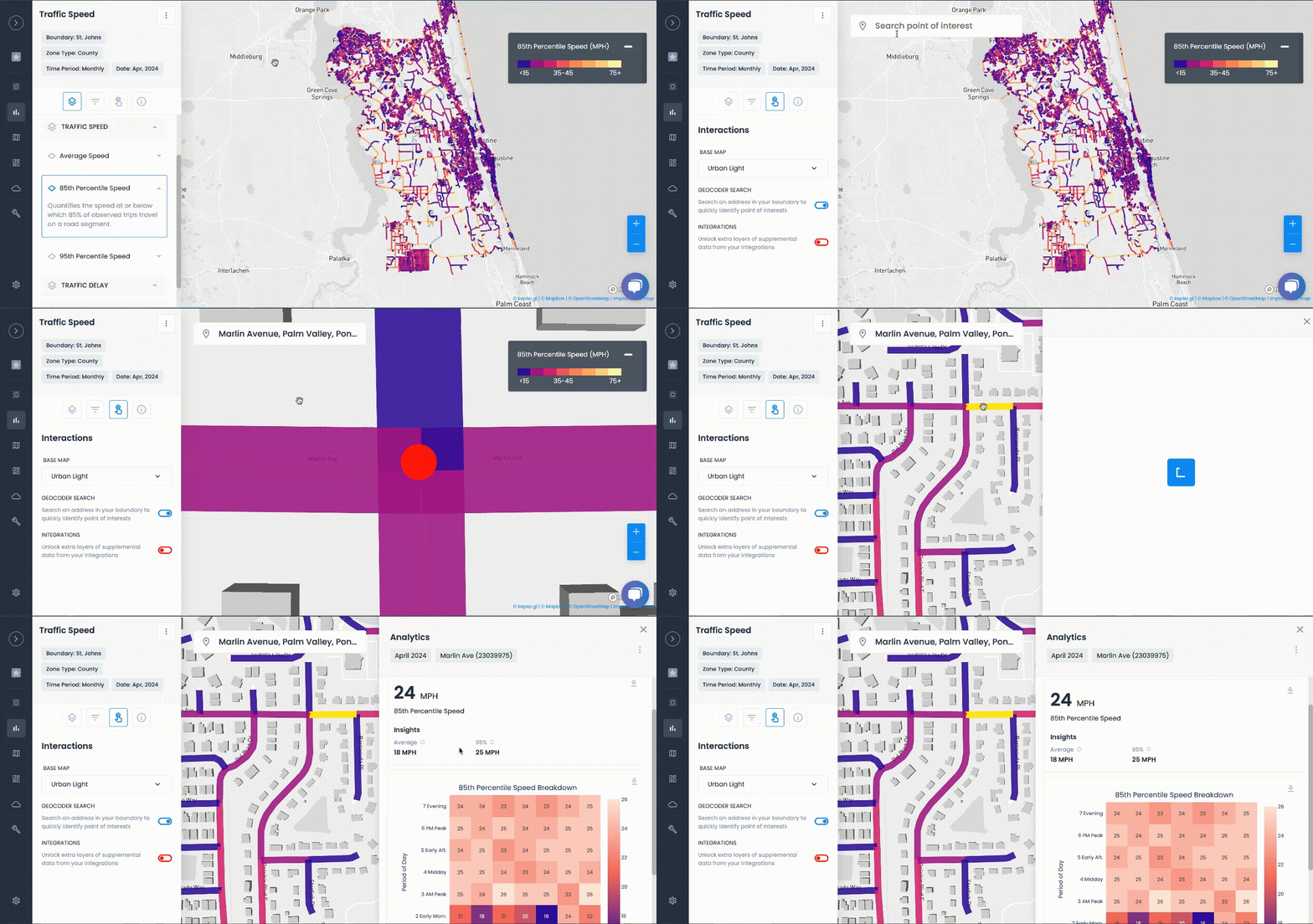
For example, Manheim Township no longer waits weeks to validate resident concerns. Staff has the ability to open Urban SDK, select a street segment, and immediately review:
- The 85th percentile
- Average speeds
- Speed distribution
- Heat maps
- Seasonal trend graphs
What used to take weeks now takes less than five minutes.
More accurate speed distributions
Instead of a few days of data, continuous monitoring provides thousands of observations per month per road segment.
This enables:
- Clearer 85th percentile speeds
- Tracking speeding spikes
- Identifying patterns that only occur at certain hours
- Reviewing both normal behavior and complaint-driven anomalies
- Validating resident perception with comprehensive evidence
With physical studies, cities rely heavily on chance — hoping that the study dates reflect typical behavior. Continuous monitoring eliminates this uncertainty.
Benefits of Continuous Monitoring for City Agencies
Continuous roadway monitoring fundamentally changes how cities manage safety and respond to residents.
Faster identification of speeding hotspots
Cities no longer need to guess where speeding is occurring.
Continuous monitoring instantly reveals:
- Which roads consistently exceed posted speed limits
- What times of day the behavior peaks
- Whether certain seasons or school schedules affect speed
- How behavior compares week over week
This helps cities prioritize true hotspots instead of relying solely on resident perception.
Smarter field deployments
With continuous digital data, staff no longer need to:
- Schedule equipment
- Maintain devices
- Replace broken hardware
- Delay analysis due to rain or snow
- Navigate traffic to install or retrieve counters
This saves:
- Time
- Labor
- Budget
- Patrol resources
- Engineering attention
For Manheim Township, eliminating these deployments resulted in dramatic time savings and empowered staff to focus on more pressing traffic safety tasks.
Ability to compare normal vs. complaint-driven behavior
This is one of the biggest advantages.
Cities can look at:
- Before and after enforcement
- Before and after signage changes
- Peak hours vs. complaint time reports
- Typical weekday vs. weekend behavior
- Seasonal changes
- Long-term improvements
Physical studies cannot provide this level of insight.
More representative speed profiles
Instead of gathering a narrow sample, continuous monitoring captures:
- Tens of thousands of speed points
- Variability across seasons
- Real-world conditions (school traffic, weather changes, construction zones)
- Differences between normal traffic and outlier drivers
This yields a significantly more accurate picture of roadway behavior — improving both engineering decisions and public communication.
How Continuous Monitoring Supports Traffic Enforcement
Continuous monitoring doesn't just improve engineering — it creates smarter policing and safer communities.
Helps determine where enforcement is actually needed
Police often receive requests to patrol streets where residents perceive speeding, even when data shows compliance.
Continuous monitoring helps departments:
- Focus enforcement where it will make a meaningful impact
- Avoid unproductive deployments
- Justify decisions using verified evidence
- Optimize patrol hours around peak speeding times
This leads to better outcomes and improved public satisfaction.
Reduces unnecessary deployments
If a resident reports speeding on a local street but Urban SDK shows the 85th percentile is within 3 mph of the limit, enforcement can be redirected to true problem areas.
Manheim Township officers found this especially useful. With Urban SDK data, they quickly confirmed whether a complaint required action — reducing unnecessary patrol assignments and saving significant staff time.
Increases officer efficiency
When police have accurate data:
- They patrol intelligently
- Their time is used effectively
- They can justify enforcement decisions
- They can coordinate with engineering on calming solutions
- Their work becomes more targeted and impactful
This strengthens internal collaboration and improves public trust.
The Future of Speed Monitoring in the U.S. Cities
The shift away from physical speed studies is not a trend — it is the new standard for modern municipal operations.
AI-based automated speed insights
Artificial intelligence allows platforms like Urban SDK to:
- Identify speeding hotspots automatically
- Predict safety risks
- Detect behavior shifts over time
- Flag problem locations without resident complaints
- Correlate speeds with crash patterns
This transforms traffic safety from reactive to proactive.
Proactive monitoring and trend analysis
Continuous monitoring enables:
- Quarterly or annual speed audits
- Long-term safety planning
- Corridor-level policy evaluation
- Data-driven capital improvement decisions
- Enhanced collaboration across departments
Cities no longer wait for residents to complain — insights appear automatically.
How cities can begin transitioning
Moving away from physical speed studies is easier than many agencies expect.
Here is a practical roadmap:
1. Assess current workload
Calculate the time and cost of existing speed study workflows.
2. Identify high-volume complaint corridors
Start with your most frequently reported streets.
3. Adopt a continuous monitoring platform
This centralizes data, eliminates manual work, and enables immediate analysis.
4. Train staff and set validation protocols
Define your rules for:
- 85th percentile thresholds
- Peak speeding windows
- When enforcement is required
- When physical equipment is still necessary
5. Phase out unnecessary physical studies
Use manual studies only for specialized cases (construction, unusual conditions) and systemic issues.
Manheim Township followed a similar path — and the results were immediate and measurable.
Conclusion
Continuous speed monitoring is transforming the way cities manage roadway safety and respond to residents. By moving beyond slow, inconsistent, and labor-intensive physical speed studies, municipalities can now access real-time and historical speed insights within minutes. Urban SDK gives local governments the ability to quickly validate speeding complaints, identify true hotspots, streamline enforcement, and communicate more transparently with the community. This modern, data-driven approach strengthens public trust, improves operational efficiency, and enables agencies to build safer, more responsive transportation networks. As shown by communities like Manheim Township, what once took weeks can now be resolved in minutes with continuous monitoring.
Frequently Asked Questions
1. Why are traditional physical speed studies becoming outdated?
Physical speed studies are slow, expensive, and only capture a brief snapshot of behavior. With growing traffic volumes and higher resident expectations, cities need faster, continuous, and more representative data to respond effectively.
2. How can cities replace physical speed studies with continuous roadway monitoring?
Cities can transition by adopting continuous data tools that provide daily roadway speeds without deploying equipment. Urban SDK delivers these insights instantly, allowing staff to review accurate speed trends anytime.
3. What is continuous roadway monitoring and how does it work?
Continuous monitoring uses real mobility datasets, GPS-based telemetry, and geospatial analytics to measure speeds across road networks every day. Urban SDK compiles this data into a single system so cities can immediately evaluate roadway behavior.
4. What are the benefits of continuous speed monitoring for municipalities?
Key benefits include:
- Faster validation of speeding complaints
- More accurate speed trends
- Reduced staff workload
- Fewer field deployments
- Better enforcement decisions
- Clear, transparent communication with residents
5. How accurate is continuous monitoring compared to physical speed studies?
Continuous monitoring provides thousands of observations each month on every segment, capturing seasonal patterns, peak hours, normal behavior, and outliers. This is significantly more accurate than a 3–7 day physical study.
6. How do cities calculate the 85th percentile speed using continuous data?
Urban SDK automatically calculates the 85th percentile using large-scale, real-world speed observations. This gives cities a far clearer understanding of typical driver behavior than temporary counters.
7. How does continuous monitoring support traffic enforcement efforts?
Law enforcement officials can identify true speeding hotspots, plan enforcement around peak speeding times, reduce unnecessary patrols, and justify decisions using verified data — creating more targeted and effective operations.
8. Do cities still need physical speed studies after implementing continuous monitoring?
Physical studies may still be used for special engineering projects, construction changes, or unique roadway conditions. However, most complaint-driven speed studies can be handled instantly with continuous monitoring through Urban SDK.
9. How quickly can cities respond to speeding complaints using Urban SDK?
Instead of waiting 2–3 weeks for physical study results, staff can review speed data in minutes. This dramatically reduces backlogs and improves communication with residents.
10. How can a city get started with continuous roadway monitoring?
Cities can begin by reviewing their current speed study workload, identifying high-volume complaint corridors, and implementing Urban SDK to centralize traffic data and streamline validation.
Explore Urban SDK: https://www.urbansdk.com/
Contact the team: https://www.urbansdk.com/contact

TRAFFIC ENFORCEMENT FEATURES
80% of citizen complaints
are a perception problem
Urban SDK provides precise hourly speed data to evaluate complaints and deploy resources efficiently for the greatest impact to public safety.
Urban SDK provides precise hourly speed data to evaluate complaints and deploy resources efficiently for the greatest impact to public safety.

Target Speeding
Identify hot spots, validate monthly speeding trends and monitor vulnerable areas like school zones.

Improve Safety
Crash and citations location information to compare speed trends month over month

Fast Response
Respond to citizen complaints sooner with address search and exportable reporting

Deploy Assets
Generate maps for traffic enforcement by time of day, location or division to deploy officers to known problem areas.
RESOURCES
Customer Success
See how public sector leaders succeed with Urban SDK.


WEBINAR
Identify speeding and proactively enforce issues
See just how quick and easy it is to identify speeding, address complaints, and deploy officers.